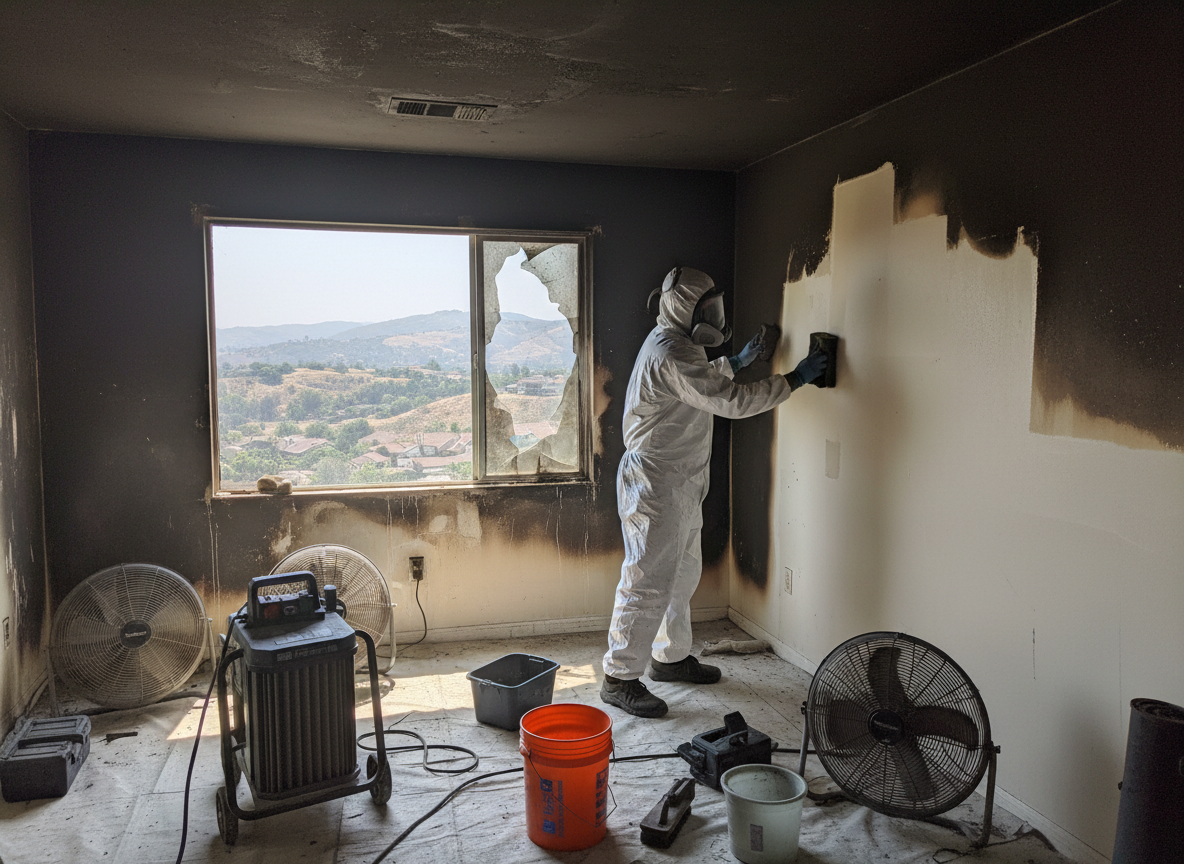
Smoke from wildfires or structure fires travels quickly through the stucco and wood-frame homes common in Porter Ranch and West Porter Ranch. In the region's hot dry summers, low humidity lets particulates embed deeply into drywall, insulation, and HVAC systems before homeowners notice. Restoration crews must address both visible soot and invisible residues that can corrode metal fixtures and trigger persistent odors if left untreated.
Los Angeles County building codes require proper ventilation and containment during cleanup to prevent cross-contamination between rooms. Technicians working near Sesnon Trail often encounter wind-driven smoke that penetrates attic spaces and crawl areas more aggressively than in flatter neighborhoods like Northridge or Chatsworth. Specialized HEPA filtration and thermal fogging become essential when standard wiping fails on textured ceilings typical of 1980s-2000s Porter Ranch construction.
Porous materials such as carpet padding, acoustic ceiling tiles, and unsealed hardwood floors absorb smoke odors that reactivate during humidity spikes. Crews evaluate each surface individually because replacement decisions depend on how far residues have migrated, not just surface appearance. This prevents callbacks that occur when only visible damage is treated in the dry climate.
Technician insight
In Porter Ranch, the thing that catches most people out with smoke damage restoration is how quickly odors reappear in homes built on the slopes near Sesnon Trail. The dry summer winds push fine particulates into wall cavities that standard cleaning misses, and the stucco exteriors common here trap moisture differently than the newer builds in West Porter Ranch, forcing extra steps during neutralization.
Smoke Residue in Attic After Nearby Brush Fire
A Porter Ranch home near the Town Center showed no visible damage after a small fire on adjacent open land. Inspection revealed heavy soot in the attic insulation and HVAC returns driven by summer winds. Crews removed contaminated insulation, cleaned ducts, and applied odor neutralizers. The family returned without recurring smells once the system was restored.
How it works
- 1
Initial Assessment and Containment
Technicians arrive from the Rinaldi Street location, document affected zones, and set up negative air pressure to stop smoke migration into unaffected areas of the home.
- 2
Surface and Air Cleaning
HEPA vacuums and specialized sponges remove loose soot from walls, ceilings, and contents while air scrubbers capture airborne particles throughout the property.
- 3
Odor Neutralization and Material Evaluation
Thermal fogging and ozone treatments address embedded odors; crews test porous materials to determine which must be removed versus cleaned.
- 4
Final Clearance and HVAC Restoration
Post-cleaning verification confirms residue removal, followed by duct cleaning and system recommissioning before reoccupancy.
Pricing
Cost depends on square footage affected, depth of smoke penetration into porous materials, and whether HVAC cleaning is needed.