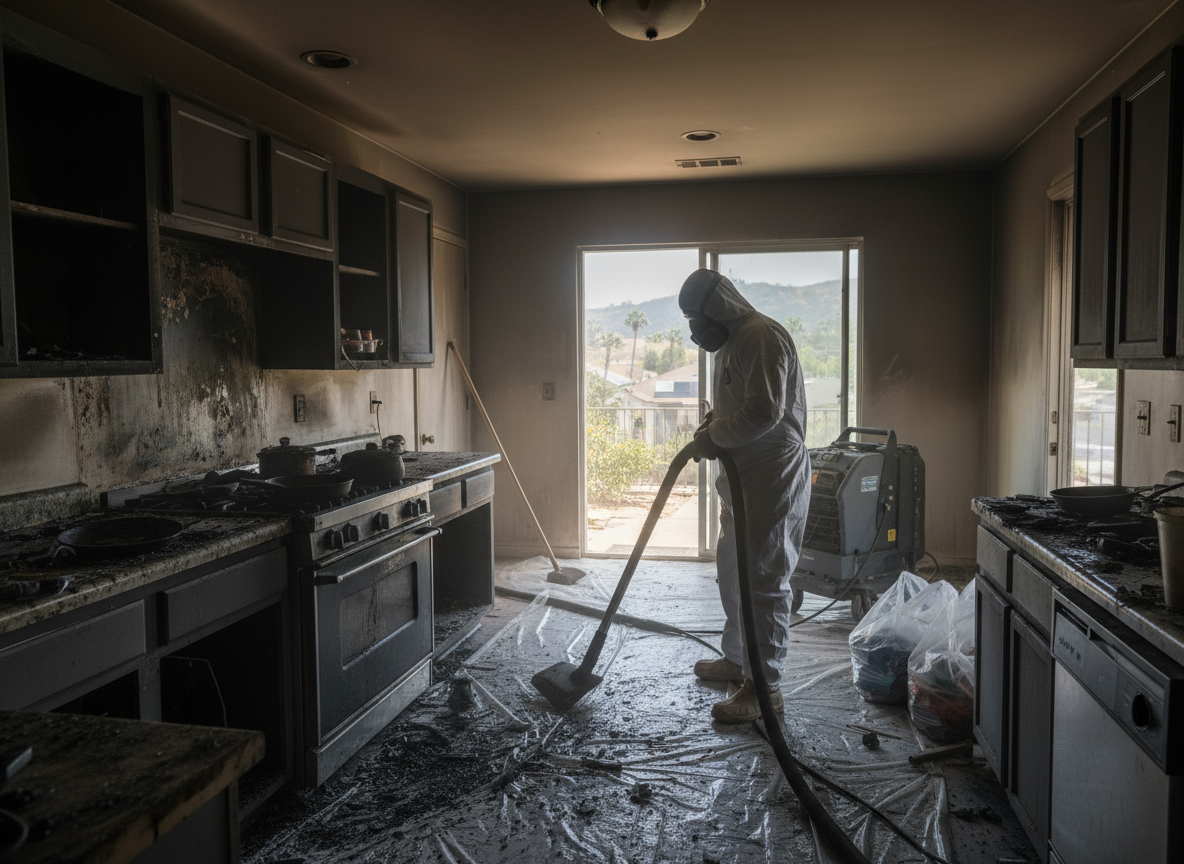
Kitchen fires in Porter Ranch often start from grease or unattended cooking and spread soot through open floor plans common in homes near the Porter Ranch Town Center. The Mediterranean climate with hot dry summers dries out residues quickly, making acidic soot etch surfaces faster than in coastal Los Angeles neighborhoods. Technicians must test for hidden grease in cabinetry and behind appliances because the same low humidity that speeds drying also lets fine particles travel through HVAC returns serving West Porter Ranch.
Sesnon Trail homes frequently have vaulted ceilings that trap smoke layers, requiring lift equipment and wall cavity inspection to prevent re-soiling after cleaning. Northridge and Chatsworth properties built in the 1980s and 1990s often contain textured drywall that holds soot in peaks, demanding gentle agitation rather than pressure washing. Failure to address these surfaces leaves odors that return when summer temperatures spike and air conditioning cycles pull air through the system.
Cleanup crews isolate the kitchen with plastic barriers before HEPA vacuuming and degreasing, then fog with odor counteractants matched to the fuel type. Electrical outlets and switch boxes are opened because grease migrates into boxes during the initial flare-up. Final clearance includes air sampling near the range hood to confirm no lingering particulates before residents return.
Technician insight
In Porter Ranch, the thing that catches most people out with kitchen fire cleanup is how the dry summer air and open layouts near Sesnon Trail let grease-laden smoke travel straight into the return vents and re-deposit on every surface once the AC kicks on again.
Grease fire in West Porter Ranch kitchen
A skillet fire spread soot across a single-story home near Porter Ranch Town Center. Inspection showed grease film inside the HVAC plenum and on textured ceilings. Crews isolated the system, removed the affected duct section, degreased all surfaces and treated the remaining cavities. The home passed air testing within four days and residents moved back without odor complaints.
How it works
- 1
Site Assessment
Technicians document burn patterns, test surfaces for pH, and map smoke paths through the HVAC system serving the kitchen.
- 2
Containment and Safety
Plastic barriers and negative air machines isolate the kitchen while crews remove charred cabinetry and unplug appliances.
- 3
Soot and Residue Removal
HEPA vacuuming followed by degreasing of walls, ceilings and ductwork using products rated for kitchen grease.
- 4
Odor Neutralization
Thermal fogging and hydroxyl treatment reach cavities and HVAC lines to eliminate smoke odor before final air testing.
Pricing
Pricing varies with the extent of smoke migration into walls and HVAC; we provide an on-site assessment before any work begins.